

War Of The Worlds Setting
 1898 U.k. start edition | |
| Writer | H. G. Wells |
|---|---|
| Country | United kingdom |
| Language | English |
| Genre | Science fiction |
| Publisher | William Heinemann (UK) Harper & Bros (US) |
| Publication date | 1898[i] |
| Pages | 287 |
| Text | The War of the Worlds at Wikisource |

The War of the Worlds, past H. One thousand. Wells. Librivox recording by Rebecca Dittman. Book 1, Chapter one.
The War of the Worlds is a science fiction novel by English author H. G. Wells, showtime serialised in 1897 by Pearson's Magazine in the United kingdom of great britain and northern ireland and by Cosmopolitan magazine in the U.s.a.. The novel's first advent in hardcover was in 1898 from publisher William Heinemann of London. Written between 1895 and 1897,[2] information technology is one of the primeval stories to particular a disharmonize betwixt mankind and an extra-terrestrial race.[3] The novel is the get-go-person narrative of both an unnamed protagonist in Surrey and of his younger brother in London as southern England is invaded by Martians. The novel is one of the most commented-on works in the science fiction catechism.[4]
The book's plot was similar to numerous works of invasion literature which were published around the aforementioned catamenia, and has been variously interpreted as a commentary on the theory of evolution, British colonialism, and Victorian-era fears, superstitions and prejudices. Wells after noted that an inspiration for the plot was the catastrophic issue of European colonisation on the Aboriginal Tasmanians; some historians have argued that Wells wrote the volume in office to encourage his readership to question the morality of imperialism.[v] At the fourth dimension of the volume's publication, it was classified as a scientific romance, like Wells's earlier novel The Time Machine.
The State of war of the Worlds has been both popular (having never been out of impress) and influential, spawning half a dozen characteristic films, radio dramas, a tape album, various comic book adaptations, a number of tv set serial, and sequels or parallel stories past other authors. It was near memorably dramatised in a 1938 radio programme directed by and starring Orson Welles that allegedly caused public panic among listeners who did not know the volume's events were fictional. The novel has even influenced the work of scientists, notably Robert H. Goddard, who, inspired past the book, helped develop both the liquid-fuelled rocket and multistage rocket, which resulted in the Apollo xi Moon landing 71 years afterwards.[half dozen] [7]
Plot [edit]
No one would have believed in the last years of the nineteenth century that this world was beingness watched keenly and closely by intelligences greater than man'due south and yet as mortal as his own... Yet beyond the gulf of infinite, minds that are to our minds as ours are to those of the beasts that perish, intellects vast and absurd and unsympathetic, regarded this world with envious optics, and slowly and surely drew their plans against us.
—H. 1000. Wells (1898), The State of war of the Worlds
The Coming of the Martians [edit]

The beginning of the alien invasion as the offset "meteor" is seen over the rooftops of London. (Corrêa, 1906)
The narrative opens by stating that as humans on World busied themselves with their own endeavours during the mid-1890s, aliens on Mars began plotting an invasion of World because their own resource are dwindling. The Narrator (who is unnamed throughout the novel) is invited to an astronomical observatory at Ottershaw where explosions are seen on the surface of the planet Mars, creating much interest in the scientific community. Months afterwards, a so-called "shooting star" lands on Horsell Common, nigh the Narrator'southward home in Woking, Surrey. He is amid the beginning to discover that the object is an artificial cylinder that opens, disgorging Martians who are "big" and "greyish" with "oily brown skin", "the size, maybe, of a conduct", each with "two big dark-coloured eyes", and lipless "V-shaped mouths" which drip saliva and are surrounded by two "Gorgon groups of tentacles". The Narrator finds them "at once vital, intense, inhuman, crippled and monstrous".[8] They emerge briefly, but have difficulty in coping with the World's atmosphere and gravity, and and so retreat speedily into their cylinder.
A man deputation (which includes the astronomer Ogilvy) approaches the cylinder with a white flag, but the Martians incinerate them and others nearby with a heat-ray earlier outset to get together their machinery. Military forces get in that night to surround the common, bringing with them field artillery and Maxim guns. The population of Woking and the surrounding villages are reassured past the presence of the British Army. A tense day begins, with much apprehension by the Narrator of armed forces action.
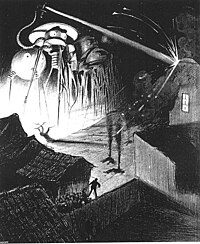
An army of Martian fighting-machines destroying England. (Corrêa, 1906)
After heavy firing from the mutual and damage to the boondocks from the heat-ray which of a sudden erupts in the tardily afternoon, the Narrator takes his wife to safety in nearby Leatherhead, where his cousin lives, using a rented, ii-wheeled horse cart. He and so returns to Woking to return the cart when in the early morning time hours, a vehement thunderstorm erupts. On the road during the pinnacle of the storm, he has his first terrifying sight of a fast-moving Martian fighting-automobile; in a panic, he crashes the horse cart, barely escaping detection. He discovers the Martians accept assembled towering 3-legged "fighting-machines" (tripods), each armed with a heat-ray and a chemical weapon: the poisonous "black fume". These tripods have wiped out the army units positioned effectually the cylinder and attacked and destroyed well-nigh of Woking. Taking shelter in his house, the Narrator sees a fleeing artilleryman moving through his garden, who subsequently tells the Narrator of his experiences and mentions that another cylinder has landed betwixt Woking and Leatherhead, which ways the Narrator is now cut off from his wife. The two try to escape via Byfleet just after dawn, but are separated at the Shepperton to Weybridge Ferry during a Martian afternoon attack on Shepperton.
One of the Martian fighting-machines is brought down in the River Thames by artillery as the Narrator and countless others try to cross the river into Middlesex, and the Martians retreat to their original crater. This gives the regime precious hours to form a defense force-line covering London. After the Martians' temporary repulse, the Narrator is able to float downward the Thames in a boat towards London, stopping at Walton, where he first encounters the curate, his companion for the coming weeks.
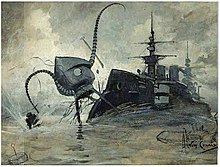
A Martian fighting-machine battling with HMS Thunder Kid. (Corréa, 1906)
Towards dusk, the Martians renew their offensive, breaking through the defence force-line of siege guns and field arms centred on Richmond Hill and Kingston Colina past a widespread battery of the black smoke; an exodus of the population of London begins. This includes the Narrator'southward younger brother, a medical student (besides unnamed), who flees to the Essex coast, after the sudden, panicked, pre-dawn order to evacuate London is given by the authorities, on a terrifying and harrowing journey of 3 days, amongst thousands of like refugees streaming from London. The brother encounters Mrs. Elphinstone and her younger sis-in-police, simply in time to help them fend off three men who are trying to rob them. Since Mrs. Elphinstone'due south hubby is missing, the three continue on together.
Later a terrifying struggle to cantankerous a streaming mass of refugees on the road at Barnet, they head east. Two days later, at Chelmsford, their pony is confiscated for food by the local Committee of Public Supply. They press on to Tillingham and the ocean. There, they manage to buy passage to Continental Europe on a small paddle steamer, role of a vast throng of shipping gathered off the Essex coast to evacuate refugees. The torpedo ram HMS Thunder Child destroys 2 attacking tripods before being destroyed past the Martians, although this allows the evacuation fleet to escape, including the ship conveying the Narrator's brother and his 2 travelling companions. Shortly thereafter, all organised resistance has collapsed, and the Martians roam the shattered landscape unhindered.
The World under the Martians [edit]

A automobile's tentacle finds a victim inside a house
At the beginning of Book Two, the Narrator and the curate are plundering houses in search of food. During this excursion, the men witness a Martian handling-machine enter Kew, seizing whatsoever person it finds and tossing them into a "smashing metal carrier which projected behind him, much as a workman's basket hangs over his shoulder",[9] and the Narrator realises that the Martian invaders may have "a purpose other than destruction" for their victims.[9] At a house in Sheen, "a blinding glare of light-green light" and a loud concussion attend the arrival of the fifth Martian cylinder,[9] and both men are trapped beneath the ruins for two weeks.

The Narrator'southward relations with the curate deteriorate over fourth dimension, and eventually he knocks him unconscious to silence his now loud ranting; the curate is overheard outside by a Martian, which eventually removes his unconscious body with one of its handling motorcar tentacles. The reader is then led to believe the Martians will perform a fatal transfusion of the curate's blood to attend themselves, as they have washed with other captured victims viewed by the Narrator through a small-scale slot in the house's ruins. The Narrator only barely escapes detection from the returned foraging tentacle by hiding in the adjacent coal-cellar.
Eventually the Martians abandon the cylinder's crater, and the Narrator emerges from the complanate house where he had observed the Martians up close during his ordeal; he then approaches West London. Enroute, he finds the Martian ruby weed everywhere, a prickly vegetation spreading wherever there is abundant water only slowly dying due to bacterial infection. On Putney Heath, one time over again he encounters the artilleryman, who persuades him of a grandiose plan to rebuild civilisation by living hush-hush; after a few hours, the Narrator perceives the laziness of his companion and abandons him. Now in a deserted and silent London, slowly he begins to become mad from his accumulated trauma, finally attempting to stop it all past openly budgeted a stationary fighting-machine. To his surprise, he discovers that all the Martians have been killed by an onslaught of earthly pathogens, to which they had no immunity: "slain, after all human being'south devices had failed, by the humblest things that God, in his wisdom, has put upon this earth".[ten]
The Narrator continues on, finally suffering a brief but complete nervous breakdown, which affects him for days; he is nursed dorsum to wellness by a kind family. Eventually, he is able to render by railroad train to Woking via a patchwork of newly repaired tracks. At his habitation, he discovers that his beloved wife has, somewhat miraculously, survived. In the concluding affiliate, the Narrator reflects on the significance of the Martian invasion, its impact on humanity's view of itself and the future, and the "abiding sense of dubiety and insecurity" information technology has left in his mind.
Style [edit]
The War of the Worlds presents itself as a factual account of the Martian invasion. It is considered 1 of the showtime works to theorise the being of a race intelligent enough to invade Earth. The Narrator is a middle-course writer of philosophical papers, somewhat reminiscent of Doctor Kemp in The Invisible Human being, with characteristics similar to author Wells at the time of writing. The reader learns very little about the background of the Narrator or indeed of anyone else in the novel; characterisation is unimportant. In fact none of the principal characters are named, aside from the astronomer Ogilvy.[11]
Scientific setting [edit]
Wells trained every bit a science instructor during the latter half of the 1880s. One of his teachers was Thomas Henry Huxley, a major advocate of Darwinism. He later taught science, and his first book was a biology textbook. He joined the scientific journal Nature equally a reviewer in 1894.[12] [xiii] Much of his piece of work is notable for making contemporary ideas of scientific discipline and technology easily understandable to readers.[14]
The scientific fascinations of the novel are established in the opening chapter where the Narrator views Mars through a telescope, and Wells offers the prototype of the superior Martians having observed homo affairs, equally though watching tiny organisms through a microscope. Ironically information technology is microscopic Earth lifeforms that finally testify deadly to the Martian invasion force.[15] In 1894 a French astronomer observed a 'foreign light' on Mars, and published his findings in the scientific journal Nature on the second of Baronial that year. Wells used this observation to open the novel, imagining these lights to be the launching of the Martian cylinders toward Earth.
The Italian astronomer Giovanni Schiaparelli observed geological features on Mars in 1878 which he called canali (Italian for "channels"). This concept was explored by American astronomer Percival Lowell in the book Mars in 1895, speculating that these might exist irrigation channels constructed past a sentient life form to back up existence on an barren, dying earth, similar to that which Wells suggests the Martians take left backside.[11] [16] The novel also presents ideas related to Charles Darwin's theory of natural selection, both in specific ideas discussed by the Narrator, and themes explored by the story.
Wells also wrote an essay titled 'Intelligence on Mars', published in 1896 in the Sabbatum Review, which sets out many of the ideas for the Martians and their planet that are used almost unchanged in The State of war of the Worlds.[11] In the essay he speculates about the nature of the Martian inhabitants and how their evolutionary progress might compare to humans. He also suggests that Mars, being an older earth than the Globe, might have become frozen and desolate, conditions that might encourage the Martians to observe some other planet on which to settle.[17] Wells has besides theorised how life could evolve in the conditions that are and so hostile like those on Mars. The creatures accept no digestive system, no appendages except tentacles and put the blood of other beings in their veins to survive. Wells was writing some years before 1901, when the Austrian Karl Landsteiner discovered the 3 human blood groups (O, A, and B), showing that even the blood of some humans tin be lethal when introduced into the veins of other humans (if they vest to incompatible blood groups). But fifty-fifty earlier that discovery, it was clearly implausible that the blood of beings from ane planet could be successfully introduced to the veins of creatures from another planet.
Physical location [edit]

In 1895, Wells was an established writer and he married his second married woman, Catherine Robbins, moving with her to the town of Woking in Surrey. There, he spent his mornings walking or cycling in the surrounding countryside, and his afternoons writing. The original idea for The War of the Worlds came from his brother during one of these walks, pondering on what it might exist like if conflicting beings were suddenly to descend on the scene and get-go attacking its inhabitants.[xviii]
Much of The War of the Worlds takes place around Woking and the surrounding area. The initial landing site of the Martian invasion force, Horsell Common, was an open area close to Wells' home. In the preface to the Atlantic edition of the novel, he wrote of his pleasure in riding a wheel effectually the area, imagining the destruction of cottages and houses he saw by the Martian rut-ray or their reddish weed.[xi] While writing the novel, Wells enjoyed shocking his friends by revealing details of the story, and how it was bringing full destruction to parts of the Southward London landscape that were familiar to them. The characters of the artilleryman, the curate, and the brother medical educatee were also based on acquaintances in Woking and Surrey.[19]
Wells wrote in a letter of the alphabet to Elizabeth Healey about his choice of locations: "I'm doing the dearest little serial for Pearson's new mag, in which I completely wreck and sack Woking – killing my neighbours in painful and eccentric ways – and so proceed via Kingston and Richmond to London, which I sack, selecting South Kensington for feats of peculiar atrocity."[20]
A 23 anxiety (7.0 m) loftier sculpture of a tripod fighting motorcar, entitled The Martian, based on descriptions in the novel stands in Crown Passage close to the local railway station in Woking, designed and constructed by artist Michael Condron.[21]
Cultural setting [edit]
Wells' depiction of tardily Victorian suburban civilization in the novel was an accurate representation of his ain experiences at the time of writing.[22] In the tardily 19th century, the British Empire was the predominant colonial ability on the earth, making its domestic heart a poignant and terrifying starting point for an invasion by Martians with their ain imperialist agenda.[23] He as well drew upon a common fearfulness which had emerged in the years budgeted the turn of the century, known at the fourth dimension as fin de siècle or 'end of the age', which anticipated an apocalypse occurring at midnight on the last twenty-four hours of 1899.[nineteen]
Publication [edit]
In the late 1890s it was common for novels, prior to full volume publication, to exist serialised in magazines or newspapers, with each part of the serialisation ending upon a cliffhanger to entice audiences to buy the next edition. This is a practice familiar from the get-go publication of Charles Dickens' novels earlier in the nineteenth century. The War of the Worlds was offset published in series class in the U.k. in Pearson's Mag in April – December 1897.[24] Wells was paid £200 and Pearsons demanded to know the catastrophe of the slice before committing to publish.[25] The complete volume was showtime published by William Heinemann (of London publishing house Heinemann) in 1898 and has been in impress ever since.[26]
Two unauthorised serialisations of the novel were published in the United States prior to the publication of the novel. The first was published in the New York Evening Journal betwixt December 1897 and January 1898. The story was published as Fighters from Mars or the War of the Worlds. It changed the location of the story to a New York setting.[27] The 2d version changed the story to have the Martians landing in the area almost and effectually Boston, and was published by The Boston Post in 1898, which Wells protested against. It was called Fighters from Mars, or the War of the Worlds in and about Boston.[12]
Both pirated versions of the story were followed by Edison'due south Conquest of Mars past Garrett P. Serviss. Even though these versions are deemed as unauthorised serialisations of the novel, information technology is possible that H. G. Wells may accept, without realising it, agreed to the serialisation in the New York Evening Journal.[28] Holt, Rinehart & Winston repressed the book in 2000, paired with The Time Auto, and commissioned Michael Koelsch to illustrate a new encompass fine art.[29]
Reception [edit]

First Martian emerging from the cylinder that had fallen from the sky
The State of war of the Worlds was more often than not received very favourably by both readers and critics upon its publication. The Illustrated London News wrote that Wells' work had "a very distinct success" when serialised in Pearson'southward mag.[30] The story did even better as a book, and reviewers rated it as "the very best work he has all the same produced".[30] The book's London publisher Heinemann had a plentiful supply of positive reviews for use in promotions, with reviewers highlighting the story'southward originality in representing Mars in a new light through the concept of an conflicting invasion of Globe.[xxx]
Writing for Harper'due south Weekly, Sidney Brooks admired Wells' writing mode: "he has complete check over his imagination, and makes it effective by turning his nearly horrible of fancies into the linguistic communication of the simplest, to the lowest degree startling denomination".[30] Praising Wells' "power of vivid realization", The Daily News reviewer wrote, "the imagination, the extraordinary ability of presentation, the moral significance of the book cannot exist contested".[30] There was, notwithstanding, some criticism of the brutal nature of the events in the narrative.[31]
Relation to invasion literature [edit]

Between 1871 and 1914 more than 60 works of fiction for adult readers describing invasions of United kingdom of great britain and northern ireland were published. The seminal piece of work was The Battle of Dorking (1871) by George Tomkyns Chesney, an army officer. The volume portrays a surprise German language attack, with a landing on the south declension of England, made possible by the distraction of the Royal Navy in colonial patrols and the army in an Irish insurrection. The German army makes curt piece of work of English militia and chop-chop marches to London. The story was published in Blackwood's Magazine in May 1871 and was and so pop that it was reprinted a month later as a pamphlet which sold lxxx,000 copies.[32] [33]
The appearance of this literature reflected the increasing feeling of anxiety and insecurity as international tensions between European Imperial powers escalated towards the outbreak of the First World War. Across the decades the nationality of the invaders tended to vary, co-ordinate to the most acutely perceived threat at the time. In the 1870s the Germans were the most mutual invaders. Towards the end of the nineteenth century, a period of strain on Anglo-French relations, and the signing of a treaty between France and Russia, caused the French to become the more common menace.[32] [33]
There are a number of plot similarities between Wells'due south book and The Battle of Dorking. In both books a ruthless enemy makes a devastating surprise attack, with the British armed forces helpless to stop its relentless advance, and both involve the destruction of the Home Counties of southern England.[33] Even so The War of the Worlds transcends the typical fascination of invasion literature with European politics, the suitability of contemporary war machine technology to deal with the armed forces of other nations, and international disputes, with its introduction of an alien adversary.[34]
Although much of invasion literature may have been less sophisticated and visionary than Wells'due south novel, it was a useful, familiar genre to support the publication success of the piece, attracting readers used to such tales. It may also have proved an important foundation for Wells's ideas as he had never seen or fought in a state of war.[35]
Scientific predictions and accuracy [edit]
Mars [edit]

Martian canals depicted by Percival Lowell
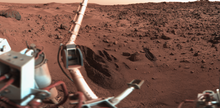
The lifeless surface of Mars every bit seen by the Viking Probe
Many novels focusing on life on other planets written close to 1900 echo scientific ideas of the time, including Pierre-Simon Laplace's nebular hypothesis, Charles Darwin'due south scientific theory of natural selection, and Gustav Kirchhoff'south theory of spectroscopy. These scientific ideas combined to nowadays the possibility that planets are alike in composition and conditions for the development of species, which would probable lead to the emergence of life at a suitable geological historic period in a planet's evolution.[36]
Past the time Wells wrote The War of the Worlds, there had been three centuries of ascertainment of Mars through telescopes. Galileo observed the planet'south phases in 1610 and in 1666 Giovanni Cassini identified the polar water ice caps.[xvi] In 1878 Italian astronomer Giovanni Schiaparelli observed geological features which he chosen canali (Italian for "channels"). This was mistranslated into English as "canals" which, being artificial watercourses, fuelled the belief in intelligent extraterrestrial life on the planet. This further influenced American astronomer Percival Lowell.[37]
In 1895 Lowell published a book titled Mars, which speculated most an arid, dying mural, whose inhabitants built canals to bring water from the polar caps to gargle the remaining arable country. This formed the most advanced scientific ideas nearly the weather condition on the cerise planet bachelor to Wells at the time The War of the Worlds was written, but the concept was later proved erroneous past more authentic observation of the planet, and later landings by Russian and American probes such as the two Viking missions, that found a lifeless world too common cold for h2o to exist in its liquid country.[16]
Space travel [edit]
The Martians travel to the Globe in cylinders, apparently fired from a huge space gun on the surface of Mars. This was a common representation of space travel in the nineteenth century, and had likewise been used by Jules Verne in From the Earth to the Moon. Modern scientific understanding renders this idea impractical, as it would be hard to control the trajectory of the gun precisely, and the forcefulness of the explosion necessary to propel the cylinder from the Martian surface to the Earth would likely kill the occupants.[38]
However, the xvi-year-old Robert H. Goddard was inspired by the story and spent much of his life building rockets.[half-dozen] [7] The work of the German rocket scientists Hermann Oberth and his educatee Wernher von Braun led to the Five-2 rocket becoming the offset artificial object to travel into space by crossing the Kármán line on 20 June 1944,[39] and rocket developments culminated in the Apollo program'southward human landing on the Moon, and the landing of robotic probes on Mars.[40]
Full state of war [edit]

The Martian invasion's primary weapons are the Heat-Ray and the poisonous Blackness Smoke. Their strategy includes the devastation of infrastructure such equally armament stores, railways, and telegraph lines; it appears to be intended to cause maximum casualties, leaving humans without whatsoever will to resist. These tactics became more common as the twentieth century progressed, particularly during the 1930s with the evolution of mobile weapons and technology capable of surgical strikes on primal military and noncombatant targets.[41]
Wells'south vision of a war bringing total destruction without moral limitations in The State of war of the Worlds was not taken seriously by readers at the time of publication. He after expanded these ideas in the novels When the Sleeper Wakes (1899), The War in the Air (1908), and The World Set Free (1914). This kind of full war did not get fully realised until the Second World War.[42]
Critic Howard Black wrote that "In concrete details the Martian Fighting Machines as depicted by Wells have nothing in common with tanks or dive bombers, but the tactical and strategic use made of them is strikingly reminiscent of Blitzkrieg as information technology would be developed by the German armed forces four decades later. The description of the Martians advancing inexorably, at lightning speed, towards London; the British Army completely unable to put upwards an effective resistance; the British authorities disintegrating and evacuating the capital; the mass of terrified refugees bottleneck the roads, all were to exist precisely enacted in real life at 1940 France." Blackness regarded this 1898 depiction equally far closer to the actual state fighting of World State of war Two than Wells's much later on piece of work The Shape of Things to Come up (1933).[43]
Weapons and armour [edit]

Wells'south description of chemical weapons – the Black Smoke used by the Martian fighting machines to impale human beings in smashing numbers – became a reality in World War I.[24] The comparison between lasers and the Heat-Ray was made every bit early equally the later half of the 1950s when lasers were all the same in development. Prototypes of mobile laser weapons take been developed and are being researched and tested as a possible futurity weapon in space.[41]
Military theorists of the era, including those of the Royal Navy prior to the First Earth War, had speculated about building a "fighting-machine" or a "land dreadnought". Wells later further explored the ideas of an armoured fighting vehicle in his short story "The Land Ironclads".[44] In that location is a high level of scientific discipline fiction abstraction in Wells's clarification of Martian automotive technology; he stresses how Martian machinery is devoid of wheels. They use "a complicated system of sliding parts" to produce movement, possess multiple whip-like tentacles for grasping, and paralleling fauna move, "quasi-muscles abounded in the crablike handling machine".[45]
Interpretations [edit]
Natural choice [edit]
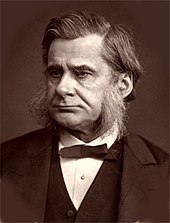
Wells's mentor, Darwinist advocate T. H. Huxley
H. Chiliad. Wells was a student of Thomas Henry Huxley, a proponent of the theory of natural selection.[46] In the novel, the conflict between mankind and the Martians is portrayed as a survival of the fittest, with the Martians whose longer period of successful development on the older Mars has led to them developing a superior intelligence, able to create weapons far in advance of humans on the younger planet Earth, who have not had the opportunity to develop sufficient intelligence to construct like weapons.[46]
Human evolution [edit]
The novel likewise suggests a potential future for homo development and perhaps a warning against overvaluing intelligence against more human qualities. The Narrator describes the Martians as having evolved an overdeveloped brain, which has left them with cumbersome bodies, with increased intelligence, but a diminished ability to apply their emotions, something Wells attributes to bodily function.
The Narrator refers to an 1893 publication suggesting that the evolution of the human brain might outstrip the development of the body, and organs such as the stomach, nose, teeth, and hair would wither, leaving humans as thinking machines, needing mechanical devices much like the Tripod fighting machines, to be able to interact with their environment. This publication is probably Wells's ain "The Man of the Yr Million", start published in The Pall Mall Gazette on 6 November 1893, which suggests similar ideas.[47] [48]
Colonialism and imperialism [edit]

Postage stamp showing the British Empire at the fourth dimension of The State of war of the Worlds' publication. Egypt was also under de facto British rule.
At the fourth dimension of the novel's publication the British Empire had conquered and colonised dozens of territories in Africa, Oceania, North and S America, the Middle East, S and Southeast Asia, and the Atlantic and Pacific islands.
While invasion literature had provided an imaginative foundation for the idea of the centre of the British Empire beingness conquered by foreign forces, information technology was not until The State of war of the Worlds that the reading public was presented with an adversary completely superior to themselves.[49] A pregnant motivating strength backside the success of the British Empire was its use of sophisticated technology; the Martians, likewise attempting to found an empire on World, have technology superior to their British adversaries.[l] In The State of war of the Worlds, Wells depicted an imperial power as the victim of imperial aggression, and thus perhaps encouraging the reader to consider imperialism itself.[49]
Wells suggests this idea in the following passage:
And earlier we approximate them [the Martians] too harshly, nosotros must remember what ruthless and utter destruction our own species has wrought, not just upon animals, such as the vanished Bison and the Dodo, but upon its own inferior races. The Tasmanians, in spite of their human likeness, were entirely swept out of existence in a war of extermination waged past European immigrants, in the infinite of 50 years. Are we such apostles of mercy equally to complain if the Martians warred in the same spirit?
—Chapter I, "The Eve of the War"
[edit]
The novel also dramatises the ideas of race presented in Social Darwinism, in that the Martians exercise over humans their 'rights' as a superior race, more advanced in development.[51]
Social Darwinism suggested that the success of these different ethnic groups in world diplomacy, and social classes in a gild, were the result of evolutionary struggle in which the group or class more fit to succeed did and then; i.e., the ability of an ethnic group to boss other ethnic groups or the chance to succeed or rise to the top of society was determined past genetic superiority. In more than modern times it is typically seen every bit dubious and unscientific for its apparent use of Darwin's ideas to justify the position of the rich and powerful, or ascendant ethnic groups.[52]
Wells himself matured in a guild wherein the merit of an private was not considered every bit of import equally their social class of origin. His begetter was a professional sportsman, which was seen as junior to 'gentle' condition; whereas his female parent had been a domestic servant, and Wells himself was, prior to his writing career, apprenticed to a draper. Trained as a scientist, he was able to chronicle his experiences of struggle to Darwin's idea of a world of struggle; but perceived science equally a rational system, which extended beyond traditional ideas of race, class and religious notions, and in fiction challenged the utilise of scientific discipline to explain political and social norms of the day.[53]
Religion and science [edit]
Skilful and evil appear relative in The State of war of the Worlds, and the defeat of the Martians has an entirely material cause: the activity of microscopic bacteria. An insane clergyman is of import in the novel, but his attempts to relate the invasion to Armageddon seem examples of his mental derangement.[48] His decease, every bit a event of his evangelical outbursts and ravings alluring the attention of the Martians, appears an indictment of his obsolete religious attitudes;[54] simply the Narrator twice prays to God, and suggests that bacteria may accept been divinely allowed to be on Earth for a reason such every bit this, suggesting a more nuanced critique.
Influences [edit]
Mars and Martians [edit]

The novel originated several enduring Martian tropes in science fiction writing. These include Mars being an aboriginal earth, nearing the end of its life, being the home of a superior civilization capable of advanced feats of science and engineering, and too being a source of invasion forces, keen to conquer the World. The commencement 2 tropes were prominent in Edgar Rice Burroughs'southward "Barsoom" series get-go with A Princess of Mars in 1912.[16]
Influential scientist Freeman Dyson, a primal figure in the search for extraterrestrial life, also acknowledged his debt to reading H. G. Wells's fictions every bit a kid.[55]
The publication and reception of The State of war of the Worlds also established the colloquial term of 'martian' as a clarification for something offworldly or unknown.[56]
Aliens and alien invasion [edit]
Antecedents [edit]
Wells is credited with establishing several extraterrestrial themes which were afterward greatly expanded by scientific discipline fiction writers in the 20th century, including first contact and state of war betwixt planets and their differing species. There were, however, stories of aliens and conflicting invasion prior to publication of The War of the Worlds.[57]
In 1727 Jonathan Swift published Gulliver'due south Travels. The tale included a people who are obsessed with mathematics and more advanced than Europeans scientifically. They populate a floating island fortress called Laputa, 4½ miles in diameter, which uses its shadow to prevent sun and pelting from reaching earthly nations over which it travels, ensuring they will pay tribute to the Laputians.[58]
Voltaire'due south Micromégas (1752) includes ii beings from Saturn and Sirius who, though homo in appearance, are of immense size and visit the Earth out of marvel. At showtime the difference in scale betwixt them and the peoples of Earth makes them call back the planet is uninhabited. When they notice the haughty Earth-axial views of World philosophers, they are greatly amused by how important Earth beings think they are compared to greater beings in the universe such as themselves.[59]
In 1892 Robert Potter, an Australian clergyman, published The Germ Growers in London. It describes a covert invasion past aliens who accept on the advent of human beings and attempt to develop a virulent illness to assist in their plans for global conquest. It was not widely read, and consequently Wells's vastly more successful novel is by and large credited equally the seminal conflicting invasion story.[57]
The first scientific discipline fiction to be fix on Mars may be Across the Zodiac: The Story of a Wrecked Record (1880) past Percy Greg. It was a long-winded book concerned with a civil war on Mars. Another Mars novel, this time dealing with chivalrous Martians coming to Earth to give humankind the do good of their advanced knowledge, was published in 1897 by Kurd Lasswitz – Two Planets (Auf Zwei Planeten). It was non translated until 1971, and thus may not have influenced Wells, although it did describe a Mars influenced by the ideas of Percival Lowell.[lx]
Other examples are Mr. Stranger's Sealed Packet (1889), which took place on Mars, Gustavus Due west. Pope'southward Journey to Mars (1894), and Ellsworth Douglas'south Pharaoh'south Broker, in which the protagonist encounters an Egyptian civilisation on Mars which, while parallel to that of the Earth, has evolved somehow independently.[61]
Early examples of influence on scientific discipline fiction [edit]
Wells had already proposed some other issue for the alien invasion story in The State of war of the Worlds. When the Narrator meets the artilleryman the second time, the artilleryman imagines a hereafter where humanity, hiding underground in sewers and tunnels, conducts a guerrilla state of war, fighting against the Martians for generations to come, and eventually, afterwards learning how to duplicate Martian weapon technology, destroys the invaders and takes back the Earth.[54]

Vi weeks after publication of the novel, The Boston Post newspaper published another alien invasion story, an unauthorised sequel to The War of the Worlds, which turned the tables on the invaders. Edison's Conquest of Mars was written past Garrett P. Serviss, a now little remembered writer, who described the inventor Thomas Edison leading a counterattack against the invaders on their home soil.[24] Though this is actually a sequel to Fighters from Mars, a revised and unauthorised reprint of The War of the Worlds, they both were first printed in the Boston Post in 1898.[62] Lazar Lagin published Major Well Andyou in the USSR in 1962, an alternative view of events in The War of the Worlds from the viewpoint of a traitor.[63]
The War of the Worlds was reprinted in the Usa in 1927, earlier the Golden Age of science fiction, by Hugo Gernsback in Astonishing Stories. John West. Campbell, some other central science fiction editor of the era, and periodic brusk story writer, published several alien invasion stories in the 1930s. Many well known science fiction writers were to follow, including Isaac Asimov, Arthur C. Clarke, Clifford D. Simak and Robert A. Heinlein with The Boob Masters and John Wyndham with The Kraken Wakes.[27]
Later examples [edit]
The theme of alien invasion has remained popular to the present twenty-four hours and is frequently used in the plots of all forms of popular entertainment including movies, television, novels, comics and video games.
Alan Moore's graphic novel, The League of Boggling Gentlemen, Volume Ii, retells the events in The War of the Worlds.
Tripods [edit]
The Tripods trilogy of books features a central theme of invasion past alien-controlled tripods.
Adaptations [edit]
The War of the Worlds has inspired seven films, as well as various radio dramas, comic-volume adaptations, video games, a number of tv series, and sequels or parallel stories past other authors. Most are set in unlike locations or eras to the original novel. Among the adaptations is the 1938 radio broadcast that was narrated and directed by Orson Welles. The kickoff two-thirds of the threescore-minute circulate were presented as a series of news bulletins, frequently described as having led to outrage and panic past listeners who believed the events described in the program to exist real.[64] In some versions of the effect, up to a one thousand thousand people ran outside in terror.[65] Later critics, still, point out that the supposed panic was exaggerated by newspapers of the fourth dimension, seeking to discredit radio as a source of news and information[66] or exploit racial stereotypes.[65] According to research by A. Brad Schwartz, fewer than 50 Americans seem to have fled outside in the wake of the broadcast, and it is not clear how many of them heard the broadcast directly.[65] [67] In 1953 came the first theatrical film of The War of the Worlds, produced by George Pal, directed by Byron Haskin, and starring Gene Barry.[68]
In 1978 a best selling musical anthology of the story was produced past Jeff Wayne, with the voices of Richard Burton and David Essex.[69] [seventy] Two after, somewhat dissimilar alive concert musical versions, based on the original album, have since been mounted by Wayne and toured throughout the United kingdom and Europe. These feature a performing prototype in 3D of Liam Neeson, alongside live guest performers. Both versions of this stage product accept utilised live music, narration, lavish projected figurer animation and graphics, pyrotechnics, and a large Martian fighting machine appears on phase and lights upwards and fires its Heat-Ray.[69] [seventy]

On xxx Oct 1988, a slightly updated version of the script by Howard Koch, adapted and directed by David Ossman, was presented by WGBH Radio, Boston and broadcast on National Public Radio for the 50th anniversary of the original Orson Welles broadcast.[71] The cast included Jason Robards in Welles' function of 'Professor Pierson', Steve Allen, Douglas Edwards, Hector Elizondo and Rene Auberjonois. A Halloween-based special episode of Hey Arnold! was aired to parody The War of the Worlds; the costumes that the chief characters wore referenced a species from Star Trek. An blithe series of Justice League from 2001 begins with a iii-function saga called "Secret Origins" and features tripod machines invading and attacking the city.
Steven Spielberg directed a 2005 pic accommodation starring Tom Cruise, which received generally positive reviews.[72] [73] The Great Martian State of war 1913–1917 is a 2013 made-for-television science fiction film docudrama that adapts The War of the Worlds and unfolds in the fashion of a documentary broadcast on The History Channel. The motion picture portrays an alternative history of World War I in which Europe and its allies, including America, fight the Martian invaders instead of Germany and its allies. The docudrama includes both new and digitally altered motion-picture show footage shot during the State of war to End All Wars to establish the telescopic of the interplanetary disharmonize. The film's original 2013 United kingdom broadcast was during the first year of the First World War centennial; the offset US cable Tv circulate came in 2014, nearly 10 months later.
In the spring of 2017, the BBC announced that in 2018 it would be producing an Edwardian period, three-episode mini-series adaptation of Wells novel. The kickoff of the iii episodes debuted in the UK on 17 November 2019.[74] Besides in 2019, Fox debuted a series adaptation set in nowadays-day Europe starring Gabriel Byrne and Elizabeth McGovern.[75]
Colin Morgan starred in The Coming of the Martians, a faithful audio dramatisation of Wells'southward 1897 novel, adapted past Nick Scovell, directed by Lisa Bowerman and produced in native 5.1 surround sound. Information technology was released in July 2018 by Sherwood Sound Studios in download format and as a two-Disc CD, a Express Edition DVD.[76]
Come across also [edit]
- Deus ex machina
- Le Monde 's 100 Books of the Century
- The Space Car
- The Second Invasion from Mars
- The Massacre of Mankind — an authorised sequel
References [edit]
Citations [edit]
- ^ Facsimile of the original 1st edition
- ^ David Y. Hughes and Harry One thousand. Geduld, A Critical Edition of The State of war of the Worlds: H.1000. Wells's Scientific Romance (Bloomington and Indianapolis: Indiana University Press, 1993), p. 1.
- ^ John L. Flynn (2005). "War of the Worlds: From Wells to Spielberg". p.5
- ^ Patrick Parrinder (2000). "Learning from Other Worlds: Estrangement, Cognition, and the Politics of Science Fiction and Utopia". P.132. Liverpool University Press
- ^ Ball, Philip (18 July 2018). "What the State of war of the Worlds means now". New Statesman . Retrieved 18 July 2018.
- ^ a b "Genesis: Search for Origins" (PDF). NASA Jet Propulsion Laboratory. Retrieved one September 2021.
{{cite web}}: CS1 maint: url-status (link) - ^ a b "Robert Goddard and His Rockets". NASA.
- ^ Wells, The War of the Worlds, Book One, Ch. four.
- ^ a b c Wells, The War of the Worlds, Book 2, Ch. 1.
- ^ Wells, The War of the Worlds, Book Two, Ch. 8.
- ^ a b c d Batchelor, John (1985). H.G. Wells . Cambridge Academy Printing. pp. 23–24. ISBN0-521-27804-X.
- ^ a b Parrinder, Patrick (1997). H.G. Wells: The Critical Heritage. Routledge. pp. 4–5. ISBN0-415-15910-v.
- ^ Parrinder, Patrick (1981). The Science Fiction of H.One thousand. Wells. Oxford University Press. pp. 15–xvi. ISBN0-xix-502812-0.
- ^ Haynes, Rosylnn D. (1980). H.G. Wells Discover of the Future. Macmillan. p. 239. ISBN0-333-27186-6.
- ^ Batchelor, John (1985). H.Chiliad. Wells . Cambridge University Printing. p. 50. ISBN0-521-27804-Ten.
- ^ a b c d Baxter, Stephen (2005). Glenn Yeffeth (ed.). "H.G. Wells' Enduring Mythos of Mars". State of war of the Worlds: Fresh Perspectives on the H.G. Wells Classic/ Edited past Glenn Yeffeth. BenBalla: 186–7. ISBNone-932100-55-v.
- ^ Haynes, Rosylnn D. (1980). H.1000. Wells Discover of the Future. Macmillan. p. 240. ISBN0-333-27186-6.
- ^ Martin, Christopher (1988). H.G. Wells. Wayland. pp. 42–43. ISBNone-85210-489-ix.
- ^ a b Flynn, John L. (2005). War of the Worlds: From Wells to Spielberg. Galactic Books. pp. 12–19. ISBN0-9769400-0-0.
- ^ Welles or Wells: The First Invasion from Mars Archived 24 October 2016 at the Wayback Machine, Phil Klass, The New York Times Review of Books, 1988
- ^ Pearson, Lynn F. (2006). Public Art Since 1950. Osprey Publishing. p. 64. ISBN0-7478-0642-10.
- ^ Lackey, Mercedes (2005). Glenn Yeffeth (ed.). "In Woking'southward Paradigm". War of the Worlds: Fresh Perspectives on the H.One thousand. Wells Archetype/ Edited by Glenn Yeffeth. BenBalla: 216. ISBNone-932100-55-5.
- ^ Franklin, H. Bruce (2008). War Stars. University of Massachusetts Press. p. 65. ISBN978-1-55849-651-iv.
- ^ a b c Gerrold, David (2005). Glenn Yeffeth (ed.). "State of war of the Worlds". State of war of the Worlds: Fresh Perspectives on the H.G. Wells Archetype/ Edited by Glenn Yeffeth. BenBalla: 202–205. ISBN9781932100556.
- ^ Parrinder, Patrick (1997). H.One thousand. Wells: The Critical Heritage. Routledge. p. eight. ISBN0-415-15910-5.
- ^ "The War of the Worlds". Encyclopaedia Britannica . Retrieved v August 2022.
- ^ a b Urbanski, Heather (2007). Plagues, Apocalypses and Bug-Eyed Monsters. McFarland. pp. 156–eight. ISBN978-0-7864-2916-5.
- ^ David Y. Hughes and Harry M. Geduld, A Critical Edition of The War of the Worlds: H.One thousand. Wells'due south Scientific Romance (Bloomington and Indianapolis: Indiana University Press, 1993), pgs 281–289.
- ^ Wells, H. 1000. (Herbert George) (2000). The time machine ; and, The state of war of the worlds. Net Archive. Austin, TX : Holt, Rinehart and Winston. ISBN978-0-03-056476-five.
- ^ a b c d e Beck, Peter J. (2016). The War of the Worlds: From H. G. Wells to Orson Welles, Jeff Wayne, Steven Spielberg and Beyond. Bloomsbury Publishing. pp. 143, 144.
- ^ Aldiss, Brian W.; Wingrove, David (1986). Trillion Year Spree: the History of Science Fiction. London: Victor Gollancz. p. 123. ISBN0-575-03943-four.
- ^ a b Eby, Cecil D. (1988). The Road to Armageddon: The Martial Spirit in English language Popular Literature, 1870–1914 . Duke University Printing. pp. 11–13. ISBN0-8223-0775-8.
- ^ a b c Batchelor, John (1985). H.G. Wells. CUP Annal. p. 7. ISBN0-521-27804-X.
- ^ Parrinder, Patrick (2000). Learning from Other Worlds . Liverpool University Press. p. 142. ISBN0-85323-584-viii.
- ^ McConnell, Frank (1981). The Scientific discipline Fiction of H.Chiliad. Wells. Oxford University Printing. p. 134. ISBN0-19-502812-0.
- ^ Guthke, Karl S. (1990). The Terminal Frontier: Imagining Other Worlds from the Copernican Revolution to Mod Fiction. Translated past Helen Atkins. Cornell University Printing. pp. 368–9. ISBN 0-8014-1680-9.
- ^ Seed, David (2005). A Companion to Scientific discipline Fiction . Blackwell Publishing. p. 546. ISBN1-4051-1218-ii.
- ^ Meadows, Arthur Jack (2007). The Hereafter of the Universe . Springer. p. 5. ISBN978-ane-85233-946-iii.
- ^ Neufeld, 1995 pp 158, 160–162, 190
- ^ Society, National Geographic (15 September 2009). "Mars Exploration, Mars Rovers Information, Facts, News, Photos – National Geographic". National Geographic. Archived from the original on ii November 2017. Retrieved half-dozen August 2022.
- ^ a b Gannon, Charles Due east. (2005). Rumours of War and Infernal Machines. Rowman & Littlefield. pp. 99–100. ISBN0-7425-4035-9.
- ^ Parrinder, Patrick (1997). H.Chiliad. Wells: The Disquisitional Heritage. Routledge. pp. 11–12. ISBN0-415-15910-5.
- ^ Howard D. Blackness. Real and Imagined Wars and Armies. The accurate and inaccurate predictions of Early Science Fiction. Jane Field (editor).
- ^ "Landships: Armored Vehicles for Colonial-era Gaming". Archived from the original on 18 February 2006. Retrieved 14 March 2006.
- ^ Wells, H. Thou.; Yeffeth, Glenn (2005). The War of the Worlds: Fresh Perspectives on the H.G. Wells Classic. BenBella Books. p. 113.
- ^ a b Williamson, Jack (2005). Glenn Yeffeth (ed.). "The Development of the Martians". War of the Worlds: Fresh Perspectives on the H.One thousand. Wells Classic/ Edited by Glenn Yeffeth. BenBella: 189–195. ISBN9781932100556.
- ^ Haynes, Rosylnn D. (1980). H.Yard. Wells Discover of the Futurity. Macmillan. pp. 129–131. ISBN0-333-27186-6.
- ^ a b Draper, Michael (1987). H.Yard. Wells. Macmillan. pp. 51–52. ISBN0-333-40747-4.
- ^ a b Zebrowski, George (2005). Glenn Yeffeth (ed.). "The Fright of the Worlds". War of the Worlds: Fresh Perspectives on the H.G. Wells Classic/ Edited by Glenn Yeffeth. BenBalla: 235–41. ISBNi-932100-55-5.
- ^ Roberts, Adam (2006). The History of Science Fiction. New York: Palgrave Macmillan. p. 148. ISBN0-333-97022-5.
- ^ Parrinder, Patrick (2000). Learning from Other Worlds . Liverpool University Printing. p. 137. ISBN0-85323-584-8.
- ^ McClellan, James Edward; Dorn, Harold (2006). Science and Technology in Earth History. JHU Press. pp. 378–90. ISBN0-8018-8360-one.
- ^ Roberts, Adam (2006). The History of Science Fiction. New York: Palgrave Macmillan. pp. 143–44. ISBN0-333-97022-five.
- ^ a b Batchelor, John (1985). H.G. Wells . Cambridge Academy Press. p. 28. ISBN0-521-27804-X.
- ^ Basalla, George (2006). Civilized Life in the Universe: Scientists on Intelligent Extraterrestrials. Oxford Academy Printing U.s.. p. 91. ISBN9780195171815.
- ^ Silverberg, Robert (2005). Glenn Yeffeth (ed.). "Introduction". War of the Worlds: Fresh Perspectives on the H.G. Wells Archetype/ Edited past Glenn Yeffeth. BenBalla: 12. ISBN1-932100-55-5.
- ^ a b Flynn, John 50. (2005). War of the Worlds: From Wells to Spielberg. Galactic Books. pp. 18–19. ISBN0-9769400-0-0.
- ^ Guthke, Karl S. (1990). The Terminal Frontier: Imagining Other Worlds from the Copernican Revolution to Modern Fiction. Translated past Helen Atkins. Cornell University Press. pp. 300–301. ISBN 0-8014-1680-ix.
- ^ Guthke, Karl S. (1990). The Last Borderland: Imagining Other Worlds from the Copernican Revolution to Modernistic Fiction. Translated past Helen Atkins. Cornell University Press. pp. 301–304. ISBN 0-8014-1680-9.
- ^ Hotakainen, Markus (2008). Mars: A Myth Turned to Mural. Springer. p. 205. ISBN978-0-387-76507-five.
- ^ Westfahl, Gary (2000). Infinite and Beyond. Greenwood Publishing Groups. p. 38. ISBN0-313-30846-two.
- ^ Edison's Conquest of Mars, "Foreword" by Robert Godwin, Apogee Books 2005
- ^ Schwartz, Matthias; Weller, Nina; Winkel, Heike (202). After Memory: World War II in Contemporary Eastern European Literatures. Walter de Gruyter GmbH & Co KG. p. 179.
- ^ Brinkley, Alan (2010). "Chapter 23 – The Keen Depression". The Unfinished Nation. p. 615. ISBN978-0-07-338552-v.
- ^ a b c Jefferson Pooley; Michael J. Socolow (thirty Oct 2018). "When historians traffic in fake news. Unraveling the myth of "State of war of the Worlds."". Washington Mail.
- ^ Pooley, Jefferson (29 October 2013). "The Myth of the 'War of the Worlds' Panic". Slate . Retrieved 16 January 2016.
- ^ Schwartz, A. Brad (2015). Broadcast Hysteria: Orson Welles's War of the Worlds and the Art of Simulated News (1st ed.). New York: Colina and Wang. ISBN978-0-8090-3161-0.
- ^ "'The War of the Worlds'." British Board of Film Classification, 9 March 1953. Retrieved 3 August 2022.
- ^ a b Burrows, Alex (26 September 2020). "The story behind Jeff Wayne's The War Of The Worlds". Louder . Retrieved five December 2020.
- ^ a b Jones, Josh (xxx March 2017). "Hear the Prog-Rock Accommodation of H.M. Wells' State of war of the Worlds: The 1978 Stone Opera That Sold 15 Million Copies Worldwide". Open up Culture . Retrieved 29 May 2019.
- ^ McDougal, Donald (15 September 1988). "50th-Anniversary 'War of the Worlds' to Air on NPR". The Orlando Sentinel . Retrieved 1 September 2021.
{{cite web}}: CS1 maint: url-status (link) - ^ "War of the Worlds". Metacritic. Retrieved 28 September 2009.
- ^ "State of war of the Worlds". Rotten Tomatoes. Retrieved 3 Feb 2012.
- ^ Nicholson, Rebecca (17 November 2019). "The War of the Worlds review – doom, dystopia and a dash of Downton". The Guardian . Retrieved 18 November 2019.
- ^ Wiseman, Andreas (29 January 2019). "'State of war Of The Worlds': Gabriel Byrne & Elizabeth McGovern Lead Cast In Sci-Fi Series From Canal+, FNG & AGC". Deadline. Archived from the original on 27 June 2019. Retrieved 3 August 2022.
- ^ "The Coming of the Martians". Starburst magazine . Retrieved 3 August 2022.
Bibliography [edit]
- Coren, Michael (1993) The Invisible Man : The Life and Liberties of H.G. Wells. Publisher: Random House of Canada. ISBN 0-394-22252-0
- Gosling, John. Waging the War of the Worlds. Jefferson, North Carolina, McFarland, 2009. Paperback, ISBN 0-7864-4105-4.
- Hughes, David Y. and Harry M. Geduld, A Critical Edition of The War of the Worlds: H.G. Wells's Scientific Romance. Bloomington and Indianapolis: Indiana University Press, 1993. ISBN 0-253-32853-five
- Roth, Christopher F. (2005) "Ufology as Anthropology: Race, Extraterrestrials, and the Occult." In E.T. Culture: Anthropology in Outerspaces, ed. by Debbora Battaglia. Durham, N.C.: Duke University Press.
- Yeffeth, Glenn (Editor) (2005) The War of the Worlds: Fresh Perspectives on the H. M. Wells Archetype. Publisher: Benbella Books. ISBN 1-932100-55-5
External links [edit]

Wikisource has original text related to this article:
- The War of the Worlds Invasion, large resource containing annotate and review on the history of The War of the Worlds
- The War of the Worlds at Standard Ebooks
- The State of war of the Worlds at Project Gutenberg.
-
 The War of the Worlds public domain audiobook at LibriVox
 - Time Archives, a expect at perceptions of The War of the Worlds over time
- Hundreds of encompass images of the book's different editions, from 1898 to now

War Of The Worlds Setting,
Source: https://en.wikipedia.org/wiki/The_War_of_the_Worlds
Posted by: stevensonblad1941.blogspot.com
0 Response to "War Of The Worlds Setting"
Post a Comment