

System Of Equation Infinite Solutions
When working with systems of linear equations, nosotros ofttimes see a unmarried solution or no solution at all. However, information technology is also possible that a linear system volition have infinitely many solutions.
So, when does a system of linear equations accept space solutions? A organization of two linear equations in two variables has space solutions if the two lines are the same. From an algebra standpoint, we go an equation that is always true if nosotros solve the organisation. Visually, the lines take the aforementioned slope and aforementioned y-intercept (they intersect at every point on the line).
Of course, a system of three equations in three variables has infinite solutions if the planes intersect in an entire line (or an entire airplane if all iii equations are equivalent).
In this article, nosotros'll talk virtually how y'all tin can tell that a system of linear equations has space solutions. We'll also look at some examples of linear systems with infinite solutions in 2 variables and in 3 variables.
Let'due south brainstorm.
Systems Of Linear Equations With Infinite Solutions
A system of linear equations tin take infinite solutions if the equations are equivalent. This means that 1 of the equations is a multiple of the other.
Information technology also means that every betoken on the line satisfies all of the equations at the same time.
The image below summarizes the 3 possible cases for the solutions for a system of two linear equations in 2 variables.
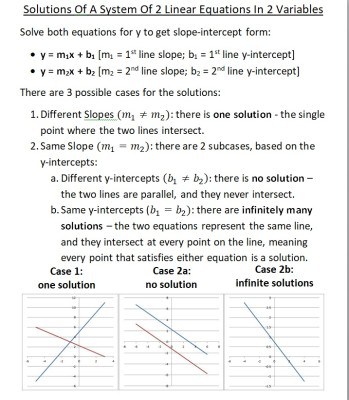
A system of equations in 2, three, or more than variables can have space solutions. We'll start with linear equations in 2 variables with infinite solution.
When Does A Linear Organisation Accept Space Solutions? (Organization Of Linear Equations In 2 Variables)
In that location are a few ways to tell when a linear system in two variables has infinite solutions:
- Solve the system – if you solve the organization and get an equation that is always true, regardless of variable value (such as 1 = 1), and so there are infinite solutions.
- Look at the graph – if the 2 lines are the same (they overlap, or intersect everywhere on the line), and then there are infinite solutions to the system.
- Await at the slope and y-intercept – solve both equations for y to become gradient-intercept form, y = mx + b. If the 2 equations take the same slope and the same y-intercept, then the lines are equivalent and there are infinite solutions (you can go a refresher on how to tell when two lines are parallel in my article hither).
We'll await at some examples of each case, starting with solving the system.
Solving A Linear System With Infinite Solutions
When we endeavour to solve a linear arrangement with infinite solutions, nosotros will get an equation that is ever true equally a result. For instance, after we simplify and combine like terms, we will become something similar 1 = 1 or five = 5.
Let'southward have a look at some examples to run into how this can happen.
Case 1: Using Elimination To Show A Linear Organization Has Infinite Solutions
Permit'southward say we desire to solve the following system of linear equations:
- 2x + 4y = three
- -6x – 12y = -9
We volition use elimination to solve. Allow's try to eliminate the "10" variable.
Nosotros begin by multiplying the first equation past iii to get:
- 3(2x + 4y) = 3(3) [multiply the first equation past 3 on both sides]
- 6x + 12y = 9 [distribute the three through parentheses]
At present we add this modified equation to the second one:
6x + 12y = ix
+
-6x – 12y = -nine
___________
0x + y = 0
This implies 0 = 0, which is e'er truthful – regardless of the values of ten or y we choose. This ways that both equations stand for the aforementioned line.
Information technology also ways that every point on that line is a solution to this linear organization. So, the system has infinite solutions.
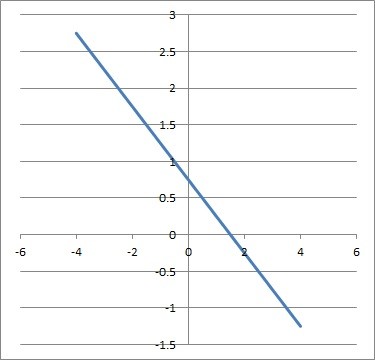
The graph below shows the line resulting from both of the equations in this organisation.
Case two: Using Substitution To Prove A Linear System Has Infinite Solutions
Let'southward say we desire to solve the following organisation of linear equations:
- y = 2x + five
- 10x – 5y = -25
We will apply substitution to solve. We'll substitute the y from the first equation into the y in the second equation:
- 10x – 5y = -25 [starting time with the 2nd equation]
- 10x – v(2x + 5) = -25 [substitute y = 2x + five from the first equation]
- 10x – 10x – 25 = -25 [distribute v through parentheses]
- 0x = 0 [combine similar terms on opposite sides]
This implies 0 = 0, which is always true – regardless of the values of x or y we cull. This means that both equations stand for the same line.
It also means that every point on that line is a solution to this linear organisation. So, the organization has space solutions.
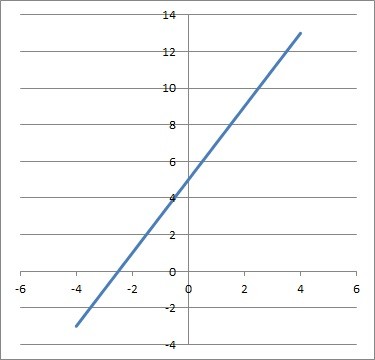
The graph below shows the line resulting from both of the equations in this system.
Looking At The Graph Of A Linear System With Infinite Solutions
When we graph a linear organisation with infinite solutions, nosotros volition get ii lines that overlap. That is, they intersect at every point on the line, since the two equations are equivalent and requite us the same line.
Allow'due south take a look at some examples to meet how this can happen.
Case ane: Graph Of Two Equivalent Equations From A Linear Organisation With Infinite Solutions
Let's graph the following system of linear equations:
- y = 2x + four
- -2y = -4x – 8
The lines have the same gradient (chiliad = 2) and the same y-intercept (b = 4), as you can see in the graph below:
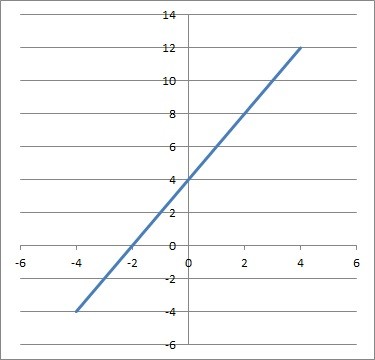
Since the slopes are the same and the y-intercepts are the same, the equations represent the same line. So, they will intersect at every point on the line.
This means that there are space solutions to the linear system we started with.
Example 2: Graph Of Ii Equivalent Equations From A Linear System With Infinite Solutions
Let's graph the following system of linear equations:
- y = 4
- 3y = 12
The lines are horizontal, and so they both have the same gradient (1000 = 0). They likewise have the same y-intercept (b = four), as you tin encounter in the graph below:
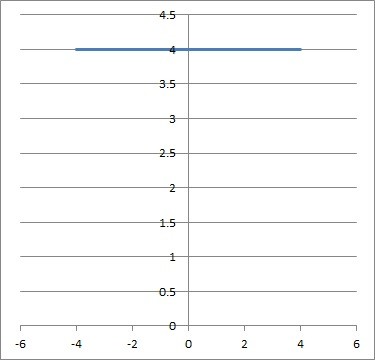
Since the slopes are the same and the y-intercepts are the same, the equations represent the same line. And so, they will intersect at every point on the line.
This means that at that place are infinite solutions to the linear organization nosotros started with.
Looking At The Slope & Y-Intercept Of A Linear System With Space Solutions
When we solve a linear equation for y, we get gradient-intercept form. If we do this for both equations in a linear system, we can compare the gradient and y-intercept.
If the two slopes are the same and the y-intercepts are the same, so the two lines are equivalent, meaning they intersect at all points on the line and there are infinite solutions to the linear organisation.
Allow's take a look at some examples to come across how this can happen.
Instance 1: Comparing Gradient & Y-Intercept To Show There Are Space Solutions To A Arrangement Of Two Linear Equations
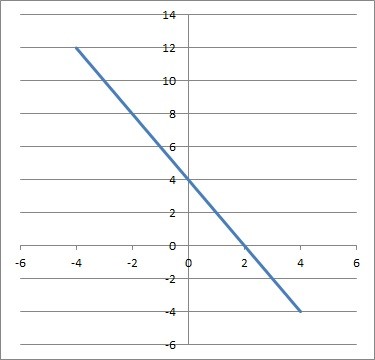
Let's say we accept the following organization of linear equations:
- 4x = – 2y + eight
- 7y = -14x + 28
We will solve for y in both equations to get slope-intercept form, y = mx + b.
Solving the starting time equation for y, we become:
- 4x = – 2y + viii
- 4x + 2y = 8 [add 2y to both sides]
- 2y = -4x + 8 [decrease 4x from both sides]
- y = -2x + 4 [divide past two on both sides]
Solving the second equation for y, we get:
- 7y = -14x + 28
- y = -2x + 4 [split up by vii on both sides]
Then, the two equations in slope-intercept course are:
- y = -2x + 4
- y = -2x + four
Since these two equations have the same slope (k = -2) and the same y-intercept (b = 4), nosotros know that they represent the same line.
Since the lines intersect at all points on the line, there are space solutions to the organisation.
Example 2: Comparison Slope & Y-Intercept To Evidence There Are Infinite Solutions To A System Of Two Linear Equations
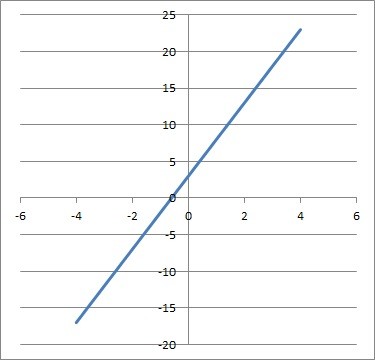
Let's say we accept the following arrangement of linear equations:
- 30x = 6y – 18
- 4y – 20x + x = 22
We will solve for y in both equations to become slope-intercept form, y = mx + b.
Solving the first equation for y, we get:
- 30x = 6y – 18
- 30x + 18 = 6y [add xviii to both sides]
- 5x + 3 = y [divide past vi on both sides]
Solving the second equation for y, we go:
- 4y – 20x + x = 22
- 4y – 20x = 22 – ten[subtract 10 from both sides]
- 4y – 20x = 12[combine like terms: constants]
- 4y = 20x + 12 [add 20x to both sides]
- y = 5x + 3 [divide by 4 on both sides]
So, the two equations in slope-intercept form are:
- y = 5x + 3
- y = 5x + iii
Since these two equations accept the aforementioned gradient (m = -2) and the same y-intercept (b = 4), we know that they correspond the same line.
Since the lines intersect at all points on the line, there are space solutions to the organisation.
How To Create A System Of Linear Equations With Infinite Solutions
To create a system of linear equations with infinite solutions, we can use the following method:
- Commencement, write a linear equation of the class ax + by = c. Side by side, choose a nonzero number d. And then, multiply both sides of the equation past d to get adx + bdy = cd. This second equation is equivalent to the start, and we take our system.
Example: Create A System Of Linear Equations With Infinite Solutions
First, nosotros choose whatever values for a, b, and c that we wish. This gives us our start equation:
- 2x + 5y = ix [nosotros chose a = two, b = 5, c = 9]
Side by side, we cull a nonzero value of d: d = 4.
At present, nosotros multiply both sides of the outset equation by d = 4:
- 2x + 5y = 9 [outset equation]
- 4(2x + 5y) = iv(9) [multiply both sides past d = 4]
- 8x + 20y = 36 [distribute 4 through parentheses]
At present we take our second equation.
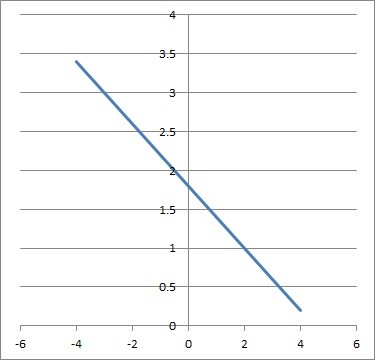
Our system of two equations is:
- 2x + 5y = 9
- 8x + 20y = 36
Since the two equations are equivalent, they represent the same line on a graph. And then, there are infinite solutions to this organization.
Organisation Of Linear Equations In Three Variables With Infinite Solutions
A system of equations in 3 variables will take space solutions if the planes intersect in an entire line or in an entire aeroplane.
The latter example occurs if all three equations are equivalent and represent the same plane.
Here is an example of the 2nd case:
- x + y + z = 1
- 2x + 2y + 2z = 2
- 3x + 3y + 3z = 3
Note that the 2d equation is the showtime equation multiplied by 2 on both sides. Also annotation that the 3rd equation is the outset equation multiplied by 3 on both sides.
Since the equations are all multiples of one another, they are equivalent. That ways they all stand for the same plane.
And then, their intersection is the entire airplane described by the equation x + y + z = 1.
This means that there are infinite solutions to the above system: every point on the airplane x + y + z = 1.
When Does A System Of Linear Equations Have A Solution?
A organization of linear equations in ii variables has a solution when the two lines intersect in at least one identify.
- If the ii lines take the same slope and the same y-intercept, then the ii equations are equivalent, and they correspond the same line (so there are infinitely many solutions, since every indicate on the line is a solution).
- If the two lines take different slopes, and then they intersect at exactly one point.
When Does A Organisation Of Linear Equations Have No Solution?
A arrangement of two linear equations in two variables has no solution when the ii lines are parallel.
From an algebra standpoint, this means that nosotros get a false equation when solving the system.
Visually, the lines never intersect on a graph, since they have the same slope merely different y-intercepts.
You can learn more about this case (and some examples) in my commodity here.
Decision
At present you know when a system of linear equations has infinite solutions. You also know what to look out for in terms of the slope, y-intercept, and graph of lines in these systems.
You can learn about systems of linear equations with one solution in my article hither and systems of linear equations with no solutions in my article here.
You can learn more than virtually slope in this article.
Yous tin learn most other equations with space solutions here.
I hope you lot constitute this article helpful. If so, please share it with someone who can utilise the information.
Don't forget to subscribe to my YouTube aqueduct & go updates on new math videos!
~Jonathon

System Of Equation Infinite Solutions,
Source: https://jdmeducational.com/systems-of-linear-equations-with-infinite-solutions-3-ways-to-tell/
Posted by: stevensonblad1941.blogspot.com
0 Response to "System Of Equation Infinite Solutions"
Post a Comment